A crack in a Jenks gunite pool is not automatically a structural problem. Oklahoma's clay-heavy soil expands and contracts through Tulsa County's wet winters and dry summers, and that movement is the single biggest…
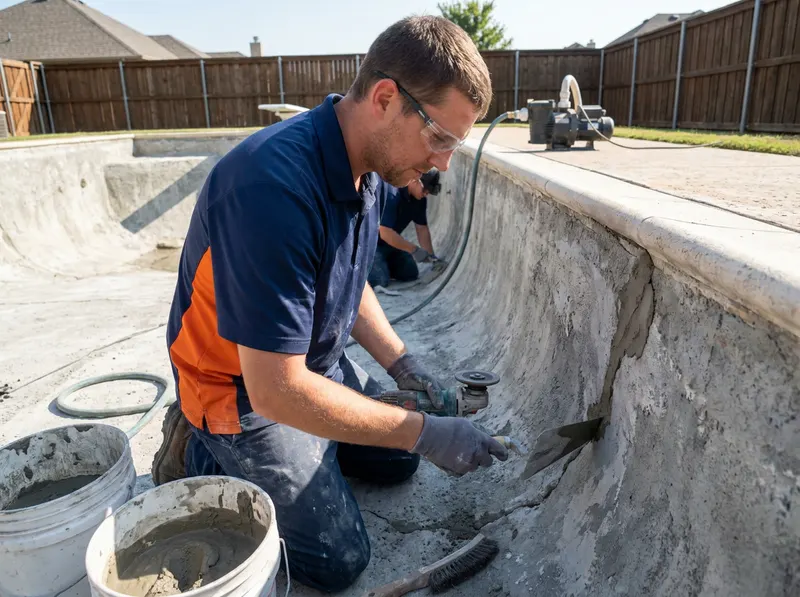
A crack in a Jenks gunite pool is not automatically a structural problem. Oklahoma's clay-heavy soil expands and contracts through Tulsa County's wet winters and dry summers, and that movement is the single biggest driver of shell cracking in pools built more than a decade ago. Many homeowners in Woodland Park and Chapel Creek, where pools were poured in the late 1990s and 2000s on that same shifting clay, see a hairline crack at the same stress points every time: the shallow-end steps, the corner where the shell meets the deck, or along a straight run near the skimmer. Those are usually cosmetic or shallow surface cracks that formed in the plaster/finish layer, not the structural gunite shell underneath, and they get sealed and injected rather than cut out.
The diagnosis that matters is whether the crack is moving. A tap test across the shell surface identifies hollow or delaminated gunite, a sign the crack has separated from the structural layer below rather than sitting only in the finish. If a crack runs the full depth of the shell, follows a straight line rather than the typical spiderweb pattern of a plaster craze crack, or shows staggered edges (one side higher than the other), that points to shell movement from soil settlement or a rebar failure, and the repair scope changes from injection to a cut-and-rebuild section. Homes on larger lots backing to the tree line near Southern Trails and Shadow Creek, where drainage grading was less consistent at time of construction, see this settlement-driven cracking more often than pools on flatter, more compacted lots closer to Stone Canyon and The Estates at Jenks.
The trade-off between the two repair paths is straightforward: crack injection is faster, cheaper, and non-invasive, but it only holds if the crack has stopped moving. Cutting out and rebuilding a shell section costs more and takes longer because it exposes and re-ties rebar, but it addresses the cause rather than sealing over active movement that will reopen the same crack within a season or two. The written scope states which category a given crack falls into and why, based on the tap test and crack pattern, before any number gets quoted, so the homeowner is not guessing whether a $400 fix or a $6,000 fix is the honest answer.
A gunite pool near Ki Kanoni or The Reserve at Woodland Park that also shows chalky texture or fading finish alongside a crack often needs both a resurfacing plan and a shell repair, since the finish layer and the structural layer wear on different timelines. The structural assessment on this page covers the shell only; if the surrounding plaster or aggregate finish is also worn, that gets scoped as a separate line item so the homeowner sees the two costs distinctly rather than one bundled number.
Every job gets a firm, written price after a free on-site visit.
Tell us about your gunite shell crack & structural repair job in Jenks and we'll send a clear, written quote, usually the same day.
 Jenks Pool Resurfacing Contractor Co.