A new plaster or pebble surface in Jenks is not finished curing when the crew leaves the yard. Fresh plaster is still releasing lime compounds into the water for weeks, which is why the water can look cloudy or feel…
A new plaster or pebble surface in Jenks is not finished curing when the crew leaves the yard. Fresh plaster is still releasing lime compounds into the water for weeks, which is why the water can look cloudy or feel slightly rough even on a correctly installed surface. Skipping the brushing schedule, letting pH swing too high during that first week, or running the pump on the wrong cycle are the three most common reasons a homeowner in Stone Canyon or Shadow Creek calls back three months later asking why their brand-new finish already has gray or blotchy staining. That staining is almost never a defect in the plaster itself; it is calcium carbonate scaling that forms when the curing water chemistry was left unmanaged.
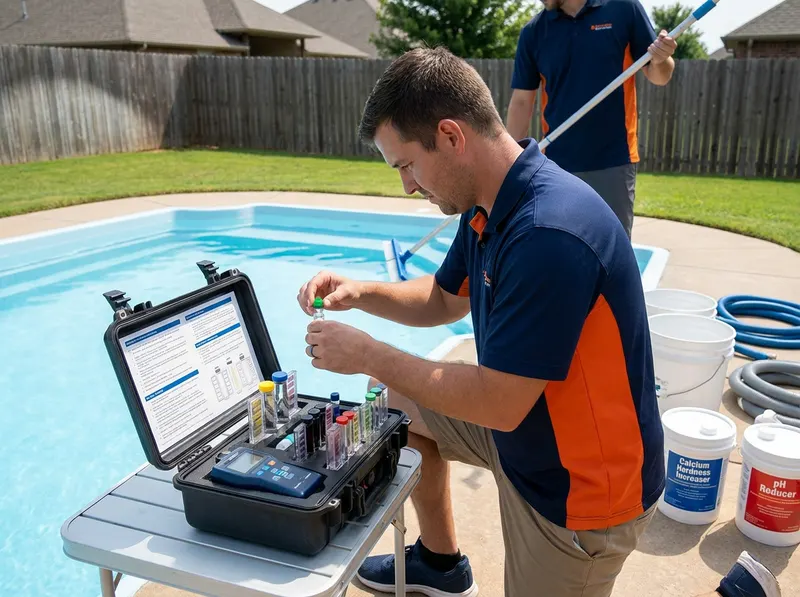
The startup sequence starts the moment the fill hose goes in. Water is run continuously to fill a typical 15,000-20,000 gallon Jenks backyard pool in roughly 8-14 hours depending on hose bore and municipal pressure, and the surface is brushed by hand 2 to 4 times a day for the first 5 to 7 days to keep plaster dust in suspension so it can be vacuumed out rather than settling and bonding into the finish. During this phase, pH, total alkalinity, and calcium hardness are tested daily rather than weekly, because plaster naturally pushes pH upward as it cures, and uncorrected high pH is the direct cause of the chalky or blotchy look homeowners in The Reserve at Woodland Park describe when a previous resurface job went wrong.
The decision that matters here is timing, not whether to do it. A homeowner doing a full resurface already has a startup and balancing period built into the contract by necessity, since no contractor can hand back a pool with fresh plaster and no cure plan. Where the trade-off shows up is in follow-through: a 30-day chemical log with daily readings costs more labor upfront than a single fill-and-walk-away visit, but it is the documentation that lets a homeowner in Chapel Creek or the Estates at Jenks prove, if a warranty question ever comes up, exactly what the water chemistry looked like during the cure window. Filter type also affects the schedule - a pool running a cartridge filter needs more frequent manual cleaning during the dusty brushing phase than one on a sand or DE system, because plaster dust loads a cartridge faster.
Running the pump on the correct cycle matters as much as the chemistry. During the first week, the pump typically runs closer to 24 hours a day rather than a normal 8-10 hour summer cycle, because continuous circulation is what keeps the curing byproducts moving toward the filter instead of settling into the new surface. Southern Trails and Ki Kanoni properties on well-shaded lots sometimes need an adjusted brushing schedule if algae spores are already present in the fill water, which is checked and treated as part of the same startup visit rather than as a separate call later.
Every job gets a firm, written price after a free on-site visit.
Tell us about your post-resurface startup & chemical balancing job in Jenks and we'll send a clear, written quote, usually the same day.
 Jenks Pool Resurfacing Contractor Co.